
SaaS Development Company — Multi-Tenant Platforms Built to Scale
Xeverse is a SaaS development company for B2B teams that need more than a prototype — multi-tenant architecture, Stripe billing, role-based access, and production-grade foundations from day one. Whether you are launching a new SaaS platform or rebuilding a single-tenant MVP into something enterprise buyers trust, we design, build, and ship systems that scale with your customer base — not against it.
B2B SaaS platforms engineered for tenants, billing, and growth
As a SaaS development company, we focus on the platform primitives that separate credible B2B products from fragile MVPs: tenant isolation, subscription billing, role-based access, and observability. Every engagement maps your go-to-market model — self-serve, sales-led, or hybrid — to an architecture your team can extend without a rewrite when ARR scales.
Multi-tenant SaaS architecture
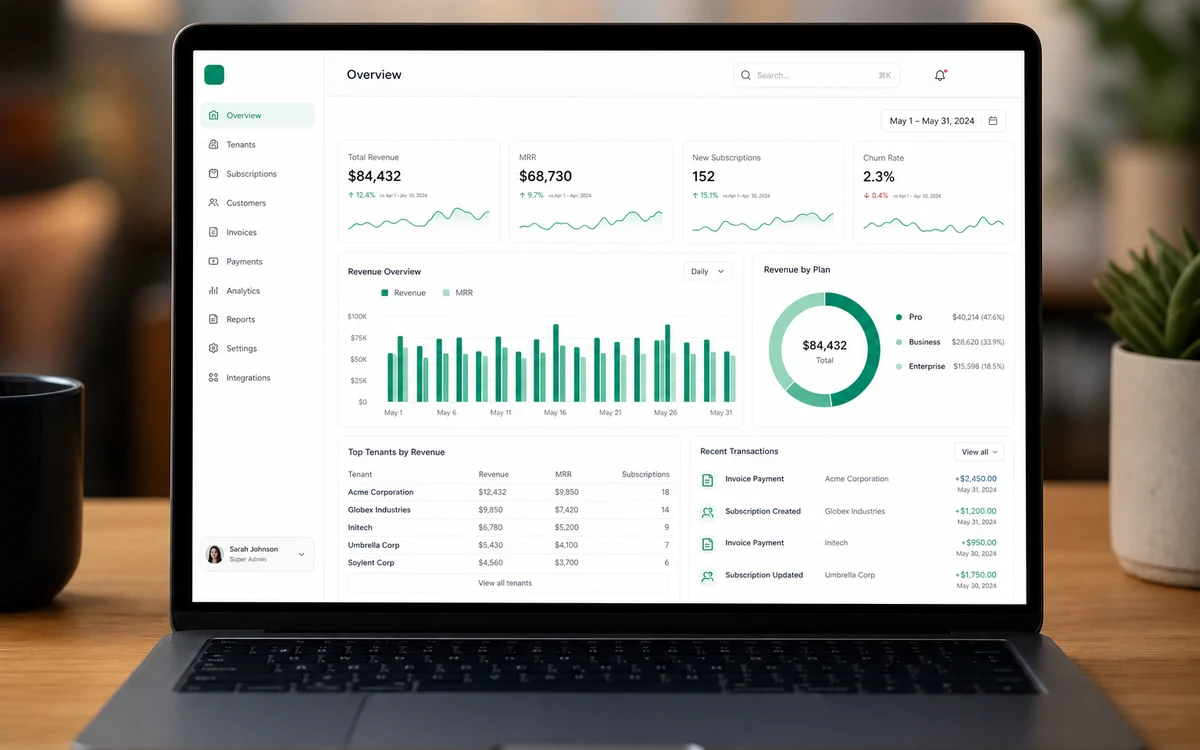
We build SaaS platforms where every organization, workspace, or account is isolated at the data layer — row-level security, tenant-scoped queries, and organization-first data models that prevent cross-customer leakage. Multi-tenant architecture is not an afterthought: it shapes auth, admin tooling, feature flags, and support workflows from sprint one. This is the same foundation we used to deliver our AI-Powered SaaS Platform case study — enterprise pilots onboarded in minutes, not manual provisioning tickets.
Billing, plans, and monetization
Stripe Billing integration for tiered subscriptions, usage-based pricing, trials, and self-serve upgrades via Checkout and Customer Portal. Webhook-driven provisioning ties payment events to tenant creation, plan limits, and feature entitlements so finance and engineering stay aligned. We implement proration, seat-based billing, and admin overrides where your pricing model requires flexibility — critical for B2B SaaS development when contracts and product-led growth coexist.
Auth, roles, and admin consoles
Role-based access control across owners, admins, members, and custom roles — with invitation flows, SSO readiness, and audit-friendly permission models. Internal admin consoles let your team impersonate tenants for support, manage subscriptions, and monitor health without direct database access. For regulated or enterprise buyers, we document access patterns and logging so security reviews move faster during sales cycles.
Discovery → architecture → build → launch → scale
Our SaaS platform development process is built for founders and product leaders who need predictable delivery without sacrificing architectural quality. Each phase produces artifacts your team can reference long after launch — tenant models, API contracts, billing flows, and a prioritized roadmap for v2.
Discovery
We map personas, pricing assumptions, tenant hierarchy, compliance constraints, and integration requirements. Workshops produce a scoped platform blueprint — what ships in v1, what is manual temporarily, and what must be production-grade before the first paying customer.
Architecture
Data model, multi-tenant strategy, API boundaries, and deployment topology are documented before feature sprints begin. You receive diagrams for auth flows, billing webhooks, and observability so engineering decisions are visible to stakeholders and investors.
Build
Two-week sprints deliver demoable increments: tenant onboarding, core workflows, Stripe integration, and admin tooling. We keep staging environments current and run QA in parallel so releases stay stable as surface area grows.
Launch
Production deployment with monitoring, error tracking, analytics instrumentation, and launch runbooks. We coordinate controlled rollouts — beta cohorts, feature flags, and support playbooks — so early customers get a reliable experience.
Scale
Post-launch we optimize query performance, harden tenant isolation, expand integrations, and prioritize features based on activation and retention data. Many clients continue for AI feature integration, agent automation, or fractional CTO advisory as the platform matures.
Production-grade SaaS platform foundations
We build B2B SaaS platforms on proven web and billing layers — multi-tenant by design, not retrofitted after your first enterprise pilot. Your stack is chosen for maintainability, security review readiness, and the ability to add plans, roles, and integrations as ARR grows.
- Next.js
- Node.js
- Stripe
- Multi-tenant architecture
- Role-based access
AI-Powered SaaS Platform
How Xeverse built a multi-tenant AI SaaS platform with Stripe billing, tenant isolation, and RAG-powered compliance workflows in 8 weeks for a FinTech startup.
Delivery timeline
8 weeks
Tenant onboarding
< 5 minutes
Manual compliance review
−62%
Another case study
B2B SaaS MVP Launch
B2B SaaS MVP launch case study: from zero to production in 10 weeks with Next.js, Stripe billing, onboarding flows, and 12-company beta — by Xeverse.
Articles for founders evaluating this service
SaaS development — common questions
How long does it take to build a SaaS platform?
Timeline depends on tenant complexity, billing model, and number of core workflows. A focused B2B SaaS platform with multi-tenant auth, one primary workflow, Stripe billing, and an admin console commonly ships in eight to twelve weeks. Platforms with advanced AI features, multiple integrations, or strict compliance requirements may extend toward fourteen to sixteen weeks. We provide a fixed-scope timeline after discovery so you know calendar and milestones before development starts — not open-ended estimates that drift. Phased delivery is available: tenant foundations and billing first, then workflow modules, then enterprise features like SSO and audit logs. Weekly demos keep stakeholders aligned. Store review, compliance review, and data migration from an existing prototype can add calendar time we flag early in discovery.
How much does SaaS MVP development cost?
SaaS platform cost varies with user roles, billing tiers, integrations, AI surfaces, and whether you are greenfield or migrating from a single-tenant prototype. After discovery we deliver a fixed-scope quote for the first production milestone rather than open-ended hourly work. Most founders budget for an eight to twelve week build when multi-tenant architecture, Stripe, and role-based access are required from launch. We align scope to your runway and fundraising timeline so you ship what validates revenue, not every feature on a wish list. Comparing proposals on scope parity matters more than headline price — extra roles and integrations ripple through auth, UI, tests, and support. Contingency for unknowns is planned explicitly, not hidden in change orders mid-build.
What tech stack should I use to build a SaaS platform?
For B2B SaaS platform development we commonly use Next.js for the web app, Node.js for APIs, PostgreSQL or Supabase for data with row-level tenant scoping, and Stripe for subscriptions. Multi-tenant architecture and role-based access are implemented at the data and middleware layers — not bolted on after the first enterprise pilot. This stack balances speed, hiring familiarity, and a clear path to scale. We select components based on your team, compliance needs, and integration surface rather than forcing a one-size template. Background jobs, email, analytics, and observability are part of production readiness. If mobile clients are primary, we share APIs across web and React Native. The rule is boring, proven defaults unless a specific component is your competitive advantage.
What is the difference between a SaaS MVP and a scalable SaaS platform?
A SaaS MVP proves demand with a thin feature set focused on one valuable workflow. A scalable platform adds tenant isolation, billing automation, observability, admin tooling, and operational rigor so growth does not break support or finance. If enterprise buyers or self-serve upgrades are part of your model, certain foundations — auth, billing webhooks, audit logs, data scoping — must be production-grade in v1. We help you draw that line explicitly so you neither over-build before traction nor ship something that requires a rewrite at Series A. MVPs can be platforms when your go-to-market requires multi-tenant safety from day one. The vocabulary matters less than honest scope: what pilots can touch in week one versus what waits for v2.
Can you rebuild our single-tenant MVP into multi-tenant SaaS?
Yes. Many engagements start with a working prototype that cannot safely onboard new organizations or bill customers automatically. We assess what to migrate, refactor, or replace — often preserving core workflow code while rebuilding auth, data scoping, Stripe integration, and admin tooling. A phased migration plan keeps existing users online while the new tenant model rolls out. Data migration scripts, dual-write periods, and feature flags reduce downtime risk. We have moved founders from spreadsheet-backed ops and single-database hacks to proper row-level security without throwing away everything that already works. Discovery produces an honest map of technical debt versus reuse so budget and timeline reflect reality, not optimism.
Do you handle AI features inside SaaS products?
Yes. We integrate LLM-powered features — copilots, document processing, RAG pipelines, classifications — with per-tenant isolation, cost controls, and human-in-the-loop review where regulated workflows require it. AI is embedded in existing screens and permissions models, not shipped as a sidecar that bypasses your auth. Vector indexes, embedding jobs, and eval harnesses are scoped alongside UI work so demos become production features. Our AI-Powered SaaS Platform case study shows multi-tenant AI with Stripe billing and operator workflows in production. We help you decide when AI belongs in v1 versus phase two based on whether it is the core differentiator or an accelerator on an already valuable workflow.
“Xeverse delivered an exceptional AI-powered platform that exceeded our expectations. Their technical depth and communication throughout was outstanding — truly a world-class team.”
Also explore
Ready to build your SaaS platform?
Tell us about your product, tenant model, and timeline. We will respond with architecture recommendations, scope, and a clear path to production.
Start your SaaS build