
How to Build an MVP in 2026: The Complete Founder Guide
An MVP is the smallest product that validates your core hypothesis with real users — not a half-built app or a slide deck. This guide walks founders through validation, scoping, tech choices, build, launch, and iteration in 2026.
What Is an MVP (and What It Isn't)
A minimum viable product (MVP) is the smallest version of your product that lets you test your riskiest assumption with real users — and learn fast enough to change course before you run out of runway. It is not a prototype you hide from customers, and it is not a stripped-down version of every feature on your roadmap.
In 2026, founders search for how to build an MVP because markets move quickly: AI capabilities, user expectations, and distribution channels shift every quarter. An MVP gives you evidence — signups, activation, retention, willingness to pay — instead of opinions from friends and investors who have not used the product.
What an MVP is: a focused first release with one primary job-to-be-done, production-grade foundations where they matter (auth, billing, data isolation), and analytics so you can measure behavior from day one. What it is not: a buggy demo, a no-code hack that cannot scale, or a six-month build that tries to match an incumbent feature-for-feature.
The goal is learning velocity. If your MVP cannot answer a clear question — Do users complete the core workflow? Will they pay? Can we acquire them affordably? — you scoped too broadly or too vaguely.
Non-technical founders often hear conflicting advice: ship in a weekend vs build properly for scale. The right answer depends on your hypothesis. If you are testing demand for a novel workflow, a narrow vertical slice in six to ten weeks beats a perfect platform in six months. If enterprise buyers require SSO and audit logs before a pilot, those items are part of viability, not nice-to-haves.
An MVP is also not permanent. Plan for iteration from the start: feature flags, modular architecture, and a backlog ranked by what the last cohort of users proved. Teams that treat MVP as a one-shot launch without instrumentation usually rediscover the same product mistakes at higher cost.
Step 1: Validate Your Idea Before Building
Before you write production code, pressure-test the problem. Talk to fifteen to thirty people in your target segment — not pitches, but structured interviews about how they solve the problem today, what they have tried, and what they would pay to fix.
Look for urgent, frequent, expensive pain. Nice-to-have problems produce MVPs that get polite praise and zero retention. Document exact quotes and workflows; these become user stories later.
Cheap validation tactics still work in 2026: landing pages with a clear value proposition, waitlists, concierge MVPs where you deliver the outcome manually, or clickable prototypes tested in moderated sessions. The bar is not zero engineering — it is not building the full platform before anyone has committed attention.
Define one north-star metric for the MVP phase: activated accounts, completed core actions per week, trial-to-paid conversion, or sales-qualified demos booked. If you cannot name the metric, you are not ready to scope build work.
Competitive research matters. If five well-funded tools already solve the job and your angle is only cheaper UI, your MVP needs a sharper wedge — niche workflow, integration depth, or AI-assisted speed that incumbents cannot match without rebuilding.
Finally, write a one-page assumption map: desirability (do they want it?), feasibility (can we build it?), viability (can we sustain it?). Circle the assumption that kills the company if wrong. Your MVP should test that one first.
- Problem interviews: current workflow, workarounds, budget authority
- Signal tests: waitlist conversion, pre-sales letters, pilot LOIs
- Anti-goals: features you explicitly will not build in v1
- Success threshold: the number that means keep going vs pivot
Step 2: Define Your MVP Scope (Feature Prioritization Framework)
Scope is where MVPs die. Founders add one more module, one more integration, one more user role — and a ten-week plan becomes a six-month trap. Use a simple prioritization framework and stick to it.
Start from the user journey, not a feature wish list. Map signup to the moment of first value. Everything on that path is candidate scope; everything else is backlog until you have retention signal.
We use a modified MoSCoW lens for MVPs: Must have for the hypothesis test, Should have only if cheap, Could have after launch, Won't have in v1 (written down so stakeholders stop re-adding them). Every Must item needs an owner and acceptance criteria.
Cut vertically, not horizontally. A thin slice through auth, core workflow, and email beats a beautiful settings page with no working engine. Horizontal layers feel productive but do not generate learning.
B2B MVPs often Must include: organization or team model, one core workflow, basic admin, and often Stripe billing if monetization is part of validation. B2C MVPs might prioritize onboarding speed, mobile experience, and share loops — but still one core loop.
Document deferred features publicly inside the team. Deferred is not denied — it is sequenced. That reduces political pressure to sneak scope into sprint two before sprint one ships.
If stakeholders disagree, tie decisions to the north-star metric. Will this feature move activation in the first thirty days? If the honest answer is maybe later, it waits.
- Core loop: trigger → action → reward → investment (habit model)
- Must-have: blocks first value if missing
- Fake-door tests: measure interest before building secondary modules
- Scope doc: one page, signed off before design starts
Step 3: Choose Your Tech Stack
Your MVP stack should optimize for speed, hiring familiarity, and a path to scale — not resume-driven novelty. In 2026, most B2B SaaS MVPs we ship use Next.js for web, Node.js or serverless APIs, PostgreSQL or Supabase for data, and Stripe when billing is in scope.
Choose boring technology for CRUD, auth, and billing. Spend innovation budget on the differentiated workflow — AI features, complex scheduling, domain-specific logic — not on rebuilding admin panels from scratch.
Mobile-first products may start with React Native if both stores matter on day one; otherwise a responsive web MVP plus native later avoids doubling surface area. Consumer apps with camera, offline, or push-heavy loops often justify mobile earlier.
AI-powered MVPs need guardrails from the start: eval datasets, human review for high-stakes outputs, and cost caps on model calls. A chat bubble without logging is not an MVP feature — it is a liability.
Avoid stacks your team cannot maintain. If you outsource build, insist on mainstream frameworks, infrastructure-as-code, and handoff documentation. MVPs become liabilities when only one contractor understands the deployment.
Multi-tenant architecture, role-based access, and observability are worth including early for B2B — not full enterprise scale, but tenant-scoped queries and error tracking so your first pilots do not leak data or fail silently.
The stack should match where you are going: if Series A buyers will ask about SOC 2, do not store secrets in flat files or skip audit logs for admin actions. Pragmatic foundations beat rewrites at month nine.
Scaling beyond MVP? See our SaaS development and AI agent development services for what comes after first release.
- Web SaaS: Next.js, TypeScript, PostgreSQL, Stripe
- Mobile: React Native + existing REST API
- AI features: model layer swappable, retrieval bounded per tenant
- Ops: staging environment, error tracking, basic CI/CD
Step 4: Build Process — How Xeverse Approaches MVP Delivery
Building an MVP is a product discipline, not a code dump. At Xeverse we run five phases — strategy, design, build, launch, iterate — each with demoable outputs so founders are never waiting months to see progress.
Strategy workshops map personas, metrics, and the Must-have scope. You leave with a prioritized backlog and explicit non-goals. Design produces clickable flows for the core journey — signup, primary workflow, paywall if applicable — approved before engineering sprint one.
Build runs in two-week sprints with staging deployments every iteration. QA, API integration, and instrumentation happen in parallel, not as a pre-launch panic week. We keep scope visible: if a request is new, something else drops or moves to v2.
Launch includes production checklist — DNS, SSL, monitoring, analytics events, support runbook — and often a controlled beta cohort rather than a public free-for-all. That protects early reputation while you fix friction.
Iterate is part of the MVP contract, not a separate project. The first release should generate data: funnel drop-off, support tickets, feature requests ranked by frequency. Sprint five and six target the highest-leverage fixes, not random stakeholder favorites.
Founders without a technical co-founder still participate in acceptance reviews each sprint. You do not need to read code — you need to verify behavior against the scope doc and say no to creep.
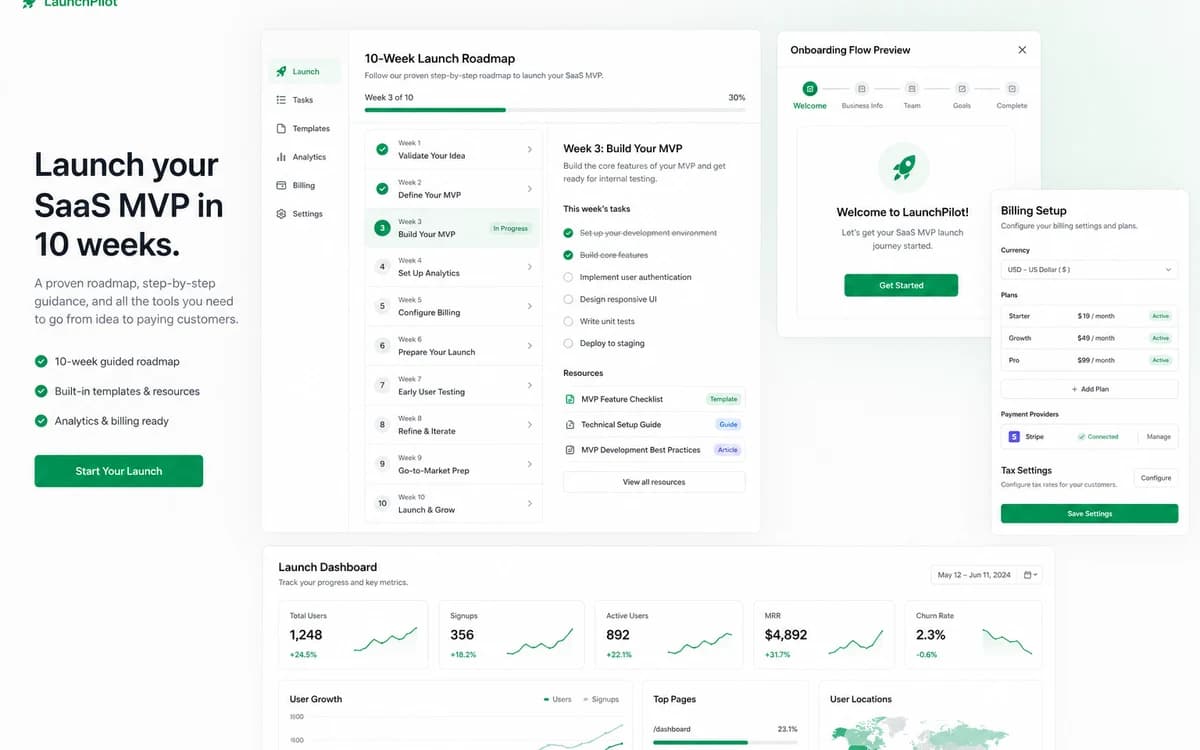
Our B2B SaaS MVP launch case study shows this model in practice: zero to production in ten weeks with onboarding, Stripe billing, and a twelve-company beta — scope held because the team treated deferred features as a signed list, not suggestions.
Our MVP development agency covers strategy, design, build, launch, and post-release iteration — see our B2B SaaS MVP launch case study for a ten-week delivery example.
- Week 1: discovery, metrics, scope sign-off
- Weeks 2–3: UX for core paths, technical spike if needed
- Weeks 4–8: sprint builds, weekly demos, staging always current
- Weeks 9–10: hardening, launch, beta support
- Post-launch: iteration backlog from real usage data
Step 5: Launch and Iterate
Launch day is the beginning of learning, not the finish line. Before you announce broadly, run a beta cohort of five to twenty users who match your ICP and agree to give feedback quickly.
Instrument the funnel: signup started, signup completed, core action completed, return visit within seven days. Without events, you will debate opinions instead of fixing drop-off.
Support channels should be ready — even a shared inbox — so early users can report bugs without shouting into the void. Fast replies in week one build goodwill that generic marketing cannot buy.
Iterate in tight loops: ship fixes weekly early on, measure again, promote features only when the core loop stabilizes. Founders who jump to growth spend before activation works burn cash on empty signups.
When retention is honest — users come back without you nagging — expand scope: integrations, reporting, mobile, or AI enhancements. That is the path from MVP to SaaS platform without a rewrite.
Communicate roadmap transparency to beta users. They tolerate missing features when they trust the sequence; they churn when promises feel random.
Prepare a simple release cadence document: what ships when, how breaking changes are announced, and how data migrations are handled. Early B2B users forgive missing polish less than they forgive surprise downtime.
- Beta criteria: ICP fit, willingness to meet biweekly
- Launch tiers: internal → beta → public waitlist → open
- Iteration rule: fix activation before adding modules
- Growth spend: only after core loop retention is measurable
How Long Does an MVP Take to Build?
Timeline depends on surface area, not ambition slides. A focused B2B SaaS MVP — auth, one core workflow, admin basics, Stripe billing — commonly ships in six to ten weeks with an experienced product engineering team.
Mobile plus backend together often runs eight to twelve weeks. MVPs with heavy AI, multiple integrations, or compliance reviews extend toward twelve to fourteen weeks. What blows timelines is scope creep, not framework choice.
Weekend MVPs exist for personal projects; funded founders validating revenue usually need production quality on the money path. Under-investing on auth, billing, or analytics creates a second MVP called the rewrite.
Parallel work compresses calendar time: design and API contracts while spikes run, QA embedded in sprints, staging always deployable. Serial handoffs between design agency and dev shop add months.
Ask any vendor for a fixed-scope milestone tied to a demoable staging URL, not open-ended hourly estimates. You want calendar certainty for fundraising and GTM dates.
Internal teams should plan MVP the same way: one product owner empowered to say no, one weekly demo ritual, and a definition of done that includes analytics and error monitoring — not only feature complete.
Want a scoped timeline and quote for your product? Talk to our MVP team.
- Focused B2B SaaS MVP: 6–10 weeks
- Mobile + API MVP: 8–12 weeks
- AI-heavy or regulated: 10–14 weeks
- Red flag: no staging demo by week 4
How Much Does an MVP Cost?
MVP cost is a function of scope, integrations, and who builds it — not a universal price list. A thin vertical slice with one billing plan and one workflow costs far less than multi-role enterprise software with SSO and custom reporting.
Agency-built MVPs are often priced as fixed-scope milestones after discovery, which protects founders from runaway hours. Budget for six to twelve weeks of focused build plus a iteration buffer for post-launch fixes.
Hidden costs include data migration, content entry, legal terms, app store fees, and founder time for interviews and acceptance testing. Model those explicitly.
Cheap MVPs that skip observability, tests on critical paths, or tenant isolation become expensive when your first paying customer asks security questions. Pragmatic quality on the revenue path is not gold-plating.
Compare cost to learning value: if the MVP saves six months of building the wrong product, the build investment is trivial relative to opportunity cost. If you cannot articulate what you will learn, do not fund the build yet.
Post-MVP, plan monthly iteration spend — bug fixes, activation improvements, and v2 features — as a percentage of initial build. Products that stop investing after launch usually stall when competitors iterate faster.
Want a scoped timeline and quote for your product? Talk to our MVP team.
- Discovery + fixed MVP quote beats open hourly tabs
- Scope drivers: roles, integrations, mobile, AI, compliance
- Run cost: hosting, tools, support — usually modest early
- ROI lens: validated revenue path vs extended pre-build debate
MVP Mistakes to Avoid
Building without a written scope doc is the most common mistake. Every stakeholder remembers a different conversation; only the document survives.
Optimizing for investor demos instead of user activation produces beautiful screens nobody returns to. Demo paths and real onboarding paths diverge — keep them aligned.
Choosing a stack your team cannot hire for locks you into a single vendor forever. Mainstream web and mobile stacks preserve optionality.
Skipping analytics because we will add it later means flying blind through the most important learning window. Add events when features ship, not in a pre-Series A panic.
Treating MVP as throwaway code invites a rewrite exactly when traction arrives. You do not need microservices on day one, but you do need sane boundaries and migrations.
Launching publicly before a beta cohort has survived real workflows guarantees harsh reviews and support overload. Sequence your exposure.
Ignoring non-functional requirements for B2B: email deliverability, password reset, role permissions, export, and basic admin tools. Enterprise pilots fail on these boring details.
Founders who outsource without weekly demos lose control of scope. Insist on visibility, staging access, and a single backlog you can read without a computer science degree.
- No scope doc → guaranteed creep
- Demo-only UX → weak retention
- No metrics → opinion-driven roadmap
- Big-bang public launch → reputation risk
- Throwaway architecture → painful rewrite at traction
Related reading
Frequently asked questions
What is the difference between an MVP and a prototype?
A prototype demonstrates how something might work — often disposable. An MVP is a production release scoped to learn from real users, with enough quality on critical paths that behavior data is trustworthy. You can start with prototypes in validation; an MVP is what you ship to paying or active users.
How do I know if my MVP scope is too big?
If you cannot describe the first value moment in one sentence, or your timeline exceeds twelve weeks without compliance requirements, scope is likely too large. Cut user roles, defer integrations, and ship one workflow end-to-end before adding modules.
Should I use no-code for my MVP?
No-code is fine for quick demand tests and internal tools. For B2B SaaS with custom workflows, billing, and scale expectations, you often outgrow no-code quickly. Many teams use no-code for validation, then build production on Next.js or similar when signal is clear.
When should I hire an MVP development agency?
Hire when speed and production quality matter and your team lacks full-stack capacity. Agencies accelerate discovery, design, build, and launch with established rituals. Keep building in-house if you already have senior product engineers and design — otherwise opportunity cost of delay often exceeds agency fees.
What should I do the week after MVP launch?
Review funnel analytics, read every support message, fix top three friction points, and interview five users who completed the core action and five who dropped off. Do not start major new features until activation is stable. Schedule a scope review for v2 based on data, not loudest requests.
Ready to build your MVP?
Talk to Xeverse — free consultation, reply within 24 hours.