
AI Agent Development Company — Custom Agents Built for Your Business
Xeverse is an AI agent development company that designs, builds, and deploys custom AI agents for customer support, internal operations, and agentic workflows. If you need to build AI agents that survive production — with guardrails, observability, and measurable ROI — we scope, ship, and monitor systems that replace manual work instead of demo-day prototypes.
Custom AI agents for customer, ops, and agentic workflows
As an AI automation agency, we build agents that connect to your real data, tools, and approval flows — not isolated chat widgets. Every engagement starts with workflow mapping so we know which decisions can be automated, where humans stay in the loop, and how success is measured after launch.
Customer-facing agents
Support copilots, onboarding assistants, and account-facing agents grounded in your product docs, CRM, and billing data. We implement retrieval, tone guardrails, and escalation paths so agents resolve routine requests and hand off cleanly when confidence drops. Customer-facing agents are designed for CSAT impact and reduced ticket volume — not novelty demos.
Internal operations agents
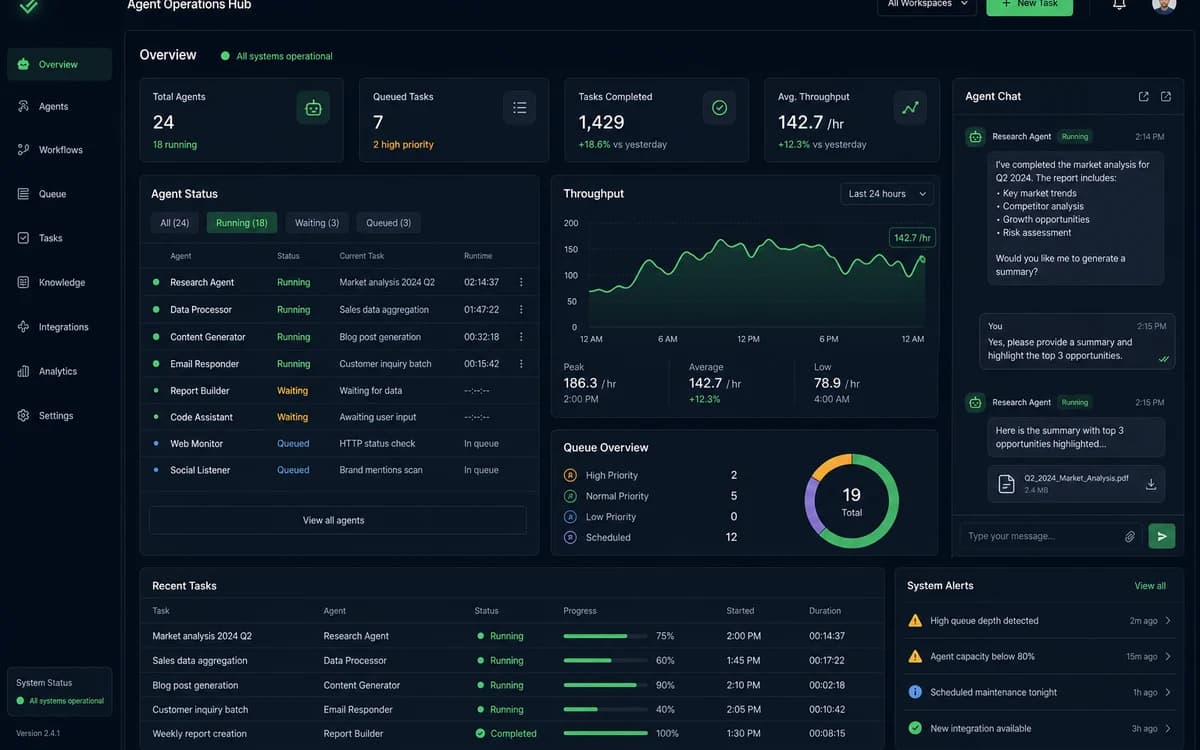
Back-office agents that intake documents, validate records, route approvals, and sync systems of record. These agents target the repetitive work that slows lean teams — the same class of workflows we automated in our AI Agent Operations Hub case study. We prioritize audit trails, role-based access, and queue reliability so ops leaders trust the system under real volume.
Agentic workflows
Multi-step agent graphs where specialized agents collaborate: extract, validate, decide, notify, and learn from feedback. Built with LangGraph-style orchestration, agentic workflows handle branching logic, retries, and human-in-the-loop gates. This is how you move from single prompts to durable automation that survives edge cases and changing business rules.
Discovery → design → build → deploy → monitor
Our process is built for founders and ops leaders who need production outcomes, not proof-of-concept theater. Each phase has clear deliverables so you know what ships when — and how we reduce risk before code hits production.
Discovery
We map the target workflow, data sources, compliance constraints, and success metrics. Stakeholder interviews and a technical audit produce a scoped agent blueprint — including what not to automate yet.
Design
Architecture, agent roles, tool integrations, and human approval gates are documented. You receive wireframes for operator consoles, a data flow diagram, and a phased rollout plan with acceptance criteria per sprint.
Build
We implement agents, orchestration, APIs, and evaluation harnesses in two-week sprints. Prompts, tools, and models are versioned; regression tests catch behavior drift before users do.
Deploy
Staging validation, security review, and production rollout with feature flags. We train your team on runbooks, configure alerts, and verify SLAs against real traffic — not synthetic happy paths only.
Monitor
Post-launch dashboards track accuracy, latency, cost per run, and hours saved. We tune thresholds, expand coverage, and iterate on failure cases so agent performance improves after go-live.
Production-grade AI agent infrastructure
We build custom AI agents on proven orchestration and data layers — not fragile prompt-only demos. Your stack is chosen for reliability, observability, and the ability to scale agent workflows as transaction volume grows.
- LangGraph
- LangChain
- OpenAI
- Python
- PostgreSQL
AI Agent Operations Hub
Case study: multi-agent AI operations hub with LangGraph, human-in-the-loop approvals, and queue automation — saving 18+ hours per week for a B2B team.
Delivery timeline
6 weeks
Manual ops hours saved
18+ hrs/week
Processing accuracy
94%
Another case study
AI-Powered SaaS Platform
How Xeverse built a multi-tenant AI SaaS platform with Stripe billing, tenant isolation, and RAG-powered compliance workflows in 8 weeks for a FinTech startup.
Articles for founders evaluating this service
AI agent development — common questions
What does an AI agent development company actually deliver?
You get production-ready agent systems — orchestration, integrations, operator UI, monitoring, evaluation harnesses, and documentation — not a standalone chatbot on a marketing page. Deliverables typically include workflow architecture, deployed agents connected to your data and tools, human-in-the-loop approval flows, structured logging, cost controls, and a handoff plan so your team can operate and extend the system. We map which decisions can be automated, where humans must stay in the loop, and how success is measured after launch. Customer-facing agents, internal ops automation, and multi-step agentic workflows are all in scope depending on your use case. The outcome is measurable ROI: fewer manual hours, faster cycle times, and reliable escalation when confidence drops.
How long does it take to build custom AI agents?
Focused single-workflow agents — one intake process, one approval chain, or one support copilot grounded in your docs — often ship in four to eight weeks after discovery. Multi-agent platforms with approvals, audit logs, CRM integrations, and operator consoles commonly run eight to twelve weeks depending on data quality, compliance review, and how many systems of record are involved. Timeline includes discovery, design, build sprints, staging validation, and production rollout with monitoring — not just model prompting. We provide a fixed-scope proposal after workflow mapping so you know calendar and milestones before committing. Pilots can start narrower and expand once metrics prove value, which reduces risk for first-time agent deployments.
Do you only work with OpenAI models?
OpenAI is our most common model provider for production agents, but we are model-agnostic where it helps your accuracy, cost, latency, or data residency requirements. We select models based on task type — extraction, classification, multi-step reasoning, tool use — and design swappable model layers so you are not locked to one vendor. Some clients use Anthropic or Google models for specific workflows; others host open models when policy requires it and ops capacity exists. The orchestration layer — LangGraph-style graphs, tool definitions, evals, and guardrails — matters more than the logo on the model API. We recommend the simplest stack that meets your bar, documented so your team can change models without rewriting the entire product.
What is the difference between AI agents and traditional automation?
Traditional automation follows fixed rules and brittle integrations — if the input format changes, the Zap breaks. AI agents reason over unstructured inputs, choose tools dynamically, handle variation in documents and requests, and collaborate in multi-step graphs with retries and escalation. Agents are appropriate when workflows include ambiguity: different email formats, exception routing, classification before action, or decisions that previously required a human reader. Rule-based automation remains right for stable, high-volume, perfectly structured tasks. We help you draw that line explicitly so you do not over-agent simple cron jobs or under-automate work that burns operator hours. Many engagements combine both: agents for variation, rules for known paths.
How do you keep AI agents reliable in production?
We use confidence thresholds, human-in-the-loop checkpoints, automated evaluations, structured logging, token budgets, and cost caps. Every agent workflow is observable: you can see what it did, which tools it called, why it escalated, and what it cost per successful run. Regression tests and scheduled evals catch behavior drift before users report it. High-stakes actions — refunds, account changes, external communications — route through approval queues by default. Dashboards track completion rate, override rate, and business outcomes like hours saved. Post-launch tuning is part of delivery, not an optional extra. Reliability is designed in from discovery, not bolted on after a demo impresses stakeholders.
Can you integrate agents with our existing stack?
Yes. We routinely integrate agents with PostgreSQL, CRMs, Slack, email, internal REST APIs, cloud storage, and ticketing systems. Agents are designed around your systems of record — not parallel silos that create more manual reconciliation. We define auth patterns, idempotent tool calls, and audit trails so operators trust automation under real volume. If data quality is weak, we scope cleansing or retrieval improvements as part of the project rather than pretending the model will guess correctly forever. Integrations are documented with runbooks for your team. Most production agents are boring on the outside — familiar UI and queues — with intelligence behind the scenes where it reduces work.
“Their AI agent systems removed hours of manual ops work every week. Practical automation with clear ROI — exactly what we needed at growth stage.”
Also explore
Ready to build custom AI agents?
Get a free scope session. We map your workflow, recommend an architecture, and estimate timeline and cost.
Get a free AI agent scope